Showing posts sorted by relevance for query Big Bang. Sort by date Show all posts

Saturday, August 23, 2008

Big Bang exploded? Seriously, is there room for reasonable skepticism about the Big Bang?

Agnostic retired Australian political science prof Hiram Caton has been tackling the huge industry of pious legends and ridiculous reverence around Charles Darwin.

I also happened to mention to him the frothier bits of speculation about the multiverse, and he replied,

Your comments and criticisms of the 'multiverse' speculation are well taken; basically it's gibberish. That peer review journals publish this stuff is a stark statement of the fallibility of scientists. Admittedly, the atheist do-gooders have a problem with the prevailing Big Bang theory of the origin of the universe: it looks like creation ex nihilo! The theory was first advanced by Father Georges Lamaitre in 1927 and was endrosed by Pope Pius XI in 1952. So Dawkins types understandably find it a bit embarrassing.

But, he notes,

There's an alternative to the Big Bang--the steady state theory, for which there's extensive empirical evidence. The steady state is rather more amenable to their position than the Big Bang, yet as far as I know they never discuss it. Maybe they don't know about it.
Steady State theory (= the universe has always existed) was - as Stephen Hawking pointed out, a good theory. For one thing it could be falsified by evidence, and the official story is that it was (see below). That compares pretty favourably with the many mere speculations that seem to dominate cosmological discussions these days.

Here's Caton's page on Steady State theory. He grumbles, "NASA's more ideology infected than the American Medical Association, which is pretty far gone."

Come to think of it, agnostic mathematician David Berlinski has also published a skeptical look at Big Bang theory.

Berlinski is skeptical of a lot of cosmology these days. Here is one of his comments from his interview with The Observer's Ron Rosenbaum (June 7, 1998)

Speaking of the knee-jerk acceptance by trade book publishers of every faddish cosmological theory in the aftermath of Stephen Hawking's success with A Brief History of Time , he said, "A lot of stuff that gets into print is simply nonsensical. Alan Guth's derivation of something from nothing [in The Inflationary Universe ] is simply incandescent horseshit . Don't tell me you're deriving something from nothing when it's transparently obvious to any mathematician that this is incandescent nonsense."
Yes, it's old, but Berlinski's recent The Devil’s Delusion: Atheism and Its Scientific Pretensions enlarges on the theme.

Like most traditional Christians, I am partial to Big Bang theory because it backs up a theist's intuitions about the universe. one evangelistic ministry aimed at the science-minded, for example, uses the Big Bang is a central apologetic device. But that is precisely the reason people like me need to stay in touch with reasonable skepticism about it.

Here's a bit of what I wrote about it in By Design or by Chance?:

The story goes that Hoyle and two other physicists, Hermann Bondi and Thomas Gold, went out one night in Cambridge in1946 to see a horror movie. It was one of those movies with a circular plot so the final scene is the same as the opening scene. Later that night, over glasses of brandy in Bondi’s apartment, the physicists were inspired to wonder if the universe is really like that movie. The end is just replaced by the beginning, over and over again.

In 1948, in a bold move, they proposed a new theory, the Steady State universe. They began by noting that the best evidence for the Big Bang is the fact that the universe is expanding. Most scientists assume that the universe is expanding from its own origin in a single point, as Lemaître had said.

However, Hoyle’s team argued, suppose the universe is expanding a little bit at a time, from everywhere at once? Perhaps hydrogen atoms, the simplest ones, can come into existence all by themselves by spontaneous generation. Just a few here and there, maybe one particle per cubic kilometre per year.9 It would add up, they said. The galaxies move apart because the new atoms shove other matter aside, and create an expanding—but still eternal—universe.

So . . . not with a Bang, but with a whimper, the universe leaks into existence.

Such a small whimper of creation eludes strict bookkeeping. To sticklers who demanded to know where all the individual newborn hydrogen atoms were coming from, the Steady State physicists replied with a question of their own: Is spontaneous creation of single atoms a bigger mystery than a Big Bang, according to which the whole universe comes into existence suddenly from nothing? So on either side there is a mystery. But which mystery is the real one?

And which is just a good plot device for a science fiction movie? That was the question they were posing.
Much later:

The Envelope, Please . . .

In the study that tested the two theories, the Big Bang predicted the correct amount of helium—about 25 percent—but the Steady State was way off.

In Hoyle’s own words:

Our results, together with further developments by William Fowler, Robert Wagoner and myself, became what even to this day is pretty well the strongest evidence for the big bang, particularly as the arguments were produced by members of what was seen as the steady state camp.

That did not stop Hoyle, who stubbornly continued to search for a No Bang theory to the end of his life. Most scientists respected him for his stubbornness, as was evident in the many eulogies written at the time of his death in 2001.17 Because he needed to find a source for atoms other than the Big Bang, he ended up doing important research on the way in which heavier elements are produced inside stars.
Find out the real reasons why there is an intelligent design controversy and why it doesn't and can't just go away:


Tuesday, September 2, 2008

Rehabilitating the idea of creation - Big Bang Cosmology

Recently, I have suggested rehabilitating the idea of creation, because the Big Bang is essentially a creationist theory. A friend writes to say:

Just a couple of observations if I may please?

1. I agree that The Big Bang is a "creationist theory". However, it is probable that one day it will be superseded. We must be careful not to lean too heavily on the current paradigm. When I meet with Reasons to Believe, for example, because of the over-arching weight they attach to Big Bang Cosmology, I warn that their apologetic may be in trouble fifty years from now. The Big Bang is something of a reigning paradigm. I mean, it's a protected sphere and access to the best telescopes are restricted to Big Bang Cosmologists - unbelievers not allowed. Yes, it's the dominant game in town, but it's not the only evidence-based game in town - see Halton Arp, for example.

And of course we have the shocking case of Guillermo Gonzalez - see your own Colliding Universes, June 18th 2008 !

[From Denyse: Sure. But in fairness, Gonzalez wasn't Expelled for doubting the Big Bang, but for suggesting that Earth is in a highly favourable location for science, rather than just being an accidental dot somewhere. What Gonzalez says is unquestionably true, but it also offends the pious atheist astronomer because it amounts to dissing St. Carl Sagan in his own Church of Astronomy. ]

2. Staying with Big Bang Cosmology, the enormous problem has to be "Where did all the energy ( the bang!) come from?" I continually marvel at the tiny amounts of Nuclear material required to do almost incalculable explosive damage - consider Hiroshima. How is it that such small masses of material contain such vast potential energy? And where did the whole lot come from in the first place?

Well, that's the big question, I guess ... how did the rabbit get into the Hat?

Tuesday, July 8, 2008

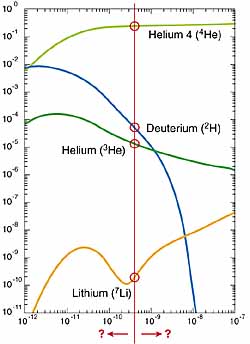
Will the rarity of the element lithium endanger the Big Bang theory?

Matthew Chalmers has a story in New Scientist (07 July 2008), "Lithium: The hole in the big bang theory", which addresses the problem the early forged light element lithium may present for the Big Bang theory (paywall). In this 2007 PhysicsWorld article, "Testing the elements of the Big Bang", Kenneth Nollett explains that most of the elements with which we are familiar (oxygen, calcium, carbon) were forged inside stars long after the Big Bang. However,

One big exception is hydrogen: almost all hydrogen nuclei are protons that emerged from the Big Bang almost 14 billion years ago. Another is light nuclei such as deuterium and lithium, which were produced in a process called Big Bang nucleosynthesis that occurred when the universe was only a few minutes old.

The nucleosynthesis, in which the other light elements, including lithium and helium, originated, is thought to have lasted only a few minutes. So why a problem?

Recent measurements of the cosmic background radiation, which reveals the universe as it was when atoms formed about 380,000 years after the Big Bang, and of the large-scale distribution of galaxies have greatly increased the precision of cosmological data. So far it seems that the observed primordial abundances – particularly those of lithium – do not quite tally with BBN theory. The goal now is to bring BBN into line with the new precision of cosmology, and to improve our understanding of the astrophysical environments where the primordial abundances are observed.
Basically,

BBN predicts that there are 4.7 × 10⁻¹⁰ lithium-7 atoms for every hydrogen atom, while the Spite-plateau stars contain only about 1.4 × 10⁻¹⁰. Several explanations for this discrepancy have been proposed, but no-one knows the right answer. Either some important physical process is missing from BBN theory, some astrophysical mechanism destroys large amounts of lithium-7 after BBN, or there is something is wrong with our interpretation of stellar spectra.
Lithium, of course, is much better known to the public than its rarity would suggest because of its fabled role in the treatment of mental illness.

(Note: The chart is from NASA's "Universe 101.")

Tuesday, November 4, 2008

"When I say it, it's science, when he says it, it's religion!"

I’ve been neglecting this blog for a while, mainly due to other work, and certainly not because there aren’t universes in collision out there!

Recently, Oxford's acclaimed physicist Roger Penrose, speaking at the Perimeter Institute for Theoretical Physics, advanced the notion of cyclical universes as more satisfactory than the now conventional Big Bang theory.

In "The big bounce vs. the big bang" National Post (October 3, 2008), Joseph Brean reports,

"The universe seems to go through cycles of some kind ... Our universe is what I call an aeon in an endless sequence of aeons," ...

He described data he received just this week that appears to show traces of the previous aeon in the microwave background radiation that fills the universe and is regarded as the lingering "flash" of the Big Bang. If it actually does, a lot of science will have to be reconsidered.

But no one gasped in awe. There were no hoots of surprise, no muttering about this seeming heresy, this contradiction of everything the general public thinks they know about the creation of the universe -- that it happened just the once, about 14 billion years ago, when space and time exploded together out of a single point, infinitely hot and dense, called a singularity. There is not supposed to be any such thing as before the Big Bang. Eternal cycles, Sir Roger? What are you, Hindu?

Penrose is not Hindu, but the idea is Hindu (and Buddhist), and it is a very old one. As Brean explains,

They all seem to be describing something very close to the account in the Hindu Rig Veda of a universe that is cyclically born and dies, each lasting a little over four million years, and representing a day in the life of the deity Brahma, or Buddhism's mahakalpa, the "great eon" between destruction and rebirth.
Brean wonders whether the aeons idea might undermine the Catholic Church’s comfortable relationship with physics. The Church, after all, teaches that the universe did have a beginning, and - not surprisingly, perhaps - it was Belgian priest Georges LeMaitre (1894-1966), pictured above, who originated the Big Bang theory, which is now the dominant one.

By contrast, the Dalai Lama acknowledges that a beginning to the universe is a problem for Eastern faiths:

From the Buddhist perspective, the idea that there is a single definite beginning is highly problematic. If there were such an absolute beginning, logically speaking, this leaves only two options. One is theism, which proposes that the universe is created by an intelligence that is totally transcendent, and therefore outside the laws of cause and effect. The second option is that the universe came into being from no cause at all. Buddhism rejects both these options. (The Universe in a Single Atom P. 82)

Penrose apparently disclaimed any theological interest to Brean,

Sir Roger was quick to point out that such theological coincidences do not figure in his research. They are no more than pleasing curiosities.

With due respect to Sir Roger, I do not believe that. Such disclaimers belong in the same category as journalists' claims to be "objective": they never have been true and never could be.

Discomfort with the Big Bang theory - for essentially theological/philosophical reasons goes back right to its origin:

Lemaître’s theory was revolutionary. It overturned a century and a half of science.
Initially, many scientists did not like the theory much, and some, like Arthur Eddington (1882–1944), said so. His comment was: “Philosophically, the notion of a beginning to the present order is repugnant to me. I should like to find a genuine loophole.” To most scientists of the day, it sounded too much like religion. Thus, Lemaître, a priest, was in the unusual position of trying to focus attention on the science that supported his idea, while many atheists were more concerned with the religious implications. This odd turnabout continues to the present day, as we will see. (Pp. 2-3 By Design or by Chance?)

The Large Hadron Collider broke some magnets and is out till mid next year, so it will b e some months whether we know if Penrose's "traces of the previous aeon" are vital evidence or faces in the clouds.

See also:


Like clouds in our coffee ... all these other universes


The Big Bang exploded; seriously, is there room for reasonable skepticism about the Big Bang?

Sunday, September 7, 2008

More demolition teams trying to blow up the Big Bang

Recently, I was looking at non-Big Bang theories, and here Discover Magazine (March 25, 2008) offers three of them, including cyclic universe, the multiverse, and the non-existence of time.

This gives you a sense of it:
It is almost as if our universe were fine-tuned to start out far from equilibrium so it could possess an arrow of time. But to a physicist, invoking fine-tuning is akin to saying “a miracle occurred.” For Carroll, the challenge was finding a process that would explain the universe’s low entropy naturally, without any appeal to incredible coincidence or (worse) to a miracle.
But, if ony by coincidence,
For each of the alternatives to the Big Bang, it is easier to demonstrate the appeal of the idea than to prove that it is correct. Steinhardt and Turok’s cyclic cosmology can account for critical pieces of evidence usually cited to support the Big Bang, but the experiments that could put it over the top are decades away. Carroll’s model of the multiverse depends on a speculative interpretation of inflationary cosmology, which is itself only loosely verified.

Barbour stands at the farthest extreme. He has no way to test his concept of Platonia. The power of his ideas rests heavily on the beauty of their formulation and on their capacity to unify physics. “What we are working out now is simple and coherent,” Barbour says, “and because of that I believe it is showing us something fundamental.”

The payoff that Barbour offers is not just a mathematical solution but a philosophical one. In place of all the conflicting notions about the Big Bang and what came before, he offers a way out. He proposes letting go of the past—of the whole idea of the past—and living fully, happily, in the Now.

In one model, each round of existence stretches a trillion years. By that reckoning, our universe is still in its infancy.
Oh well, then ... plenty of time for new theories - assuming time really exists (but some theorists say it doesn't, right?).

See also:

"Big Bang exploded? Seriously, is there room for reasonable skepticism about the Big Bang?"

"Hello, God: This is the Big Bang. Okay, look, I done it. What do I do NOW?"

Tuesday, January 18, 2011

Word on the street: The clock did SO start at the Big Bang!

Here Edwin Cartlidge reports,
Our view of the early Universe may be full of mysterious circles — and even triangles — but that doesn't mean we're seeing evidence of events that took place before the Big Bang. So says a trio of papers taking aim at a recent claim that concentric rings of uniform temperature within the cosmic microwave background — the radiation left over from the Big Bang — might, in fact, be the signatures of black holes colliding in a previous cosmic 'aeon' that existed before our Universe.

[ ... ]

Penrose, however, thinks that the Universe's great uniformity instead originates from before the Big Bang, from the tail end of a previous aeon that saw the Universe expand to become infinitely large and very smooth. That aeon in turn was born in a Big Bang that emerged from the end of a still earlier aeon, and so on, creating a potentially infinite cycle with no beginning and no end.

Now Gurzadyan and Penrose's idea is being challenged by three independent studies, all posted on the arXiv server within the past few days, by Ingunn Wehus and Hans Kristian Eriksen of the University of Oslo2; Adam Moss, Douglas Scott and James Zibin of the University of British Columbia3 in Vancouver, Canada; and Amir Hajian of the Canadian Institute for Theoretical Astrophysics in Toronto, Ontario4.

- “No evidence of time before Big Bang: Latest research deflates the idea that the Universe cycles for eternity.” Nature News (10 December 2010)
Sounds like bash Roger (“eternally cycling universe”) Penrose”time again (he’s fronting the view they oppose, that things happened before the Big Bang).

Best guess: Penrose gets all the press because the pop sci public needs new universes.

Tuesday, January 11, 2011

Before the Big Bang: Loop quantum gravity?

Big Bang,Wikimedia Commons


In “The Birth of Time: Quantum Loops Describe the Evolution of the Universe” (ScienceDaily, Dec. 17, 2010), we learn
What was the Big Bang and what happened before it? Scientists from the Faculty of Physics, University of Warsaw have attempted to answer the question. Within the framework of loop quantum gravity they have put forward a new theoretical model, which might prove useful for validating hypotheses about events prior to the Big Bang. This achievement is one of the few models describing the full Einstein's theory and not merely its greatly simplified version.
The model invokes quantum loop gravity:
The real answer to the mystery of the Big Bang lies in a unified quantum theory of matter and gravity. One attempt at developing such a theory is loop quantum gravity (LQG). The theory holds that space is weaved from one-dimensional threads. "It is just like in the case of a fabric -- although it is seemingly smooth from a distance, it becomes evident at close quarters that it consists of a network of fibres," describes Wojciech Kaminski, MSc from FUW. Such space would constitute a fine fabric - an area of a square centimetre would consists of 10^66 threads.
Question: If unified quantum theory is the real answer to the mystery of the Big Bang, won’t it end up being the next mystery? Of course, that will hardly be bad for the people who developed the theory.

It’s a bit difficult to picture a one-dimensional string, but we keep trying.

Saturday, October 30, 2010

Vid: The prequel to the Big Bang?

A friend points to a popular overview of current ideas in theoretical physics on pre-Big Bang cosmology, check out "What Happened Before the Big Bang?" a recent episode of the BBC's Horizon series.

It's on YouTube in six parts, featuring Michio Kaku, Neil Turok, Lee Smolin, Andre Linde, Roger Penrose, and Laura Mersini-Hougton


What do you think? Is this science or wishful thinking?

To comment, go here.

See also:

More demolition teams trying to blow up the Big Bang

Big Bang exploded?: Seriously, is there room for reasonable skepticism about the Big Bang?

For Roger Penrose: "When I say it, it's science; when he says it, it'sreligion!

For Lee Smolin: Can the laws of physics evolve?

and

Like clouds in our coffee ... all these other universes

For Neil Turok: So Stephen Hawking is coming to Canada, sort of

Thursday, March 26, 2009

Plasma theory: An alternative to the Big Bang?

A friend writes to say,
Timothy Eastman advocates plasma theory as the most promising alternative to a big bang cosmogony. A good book on this subject is by Eric Lerner Ph.D., a science journalist who titled it The Big Bang Never Happened. It's a fascinating study, because if the Big Bang is abandoned, some of the biggest stars in our firmament (Hubble, Lemaitre, Guth, Dirac, Hawking, Rees, and more) will have to start from scratch.
I think the Big Bang probably did happen, and I am not threatened by people who think otherwise, so I suggest reading what these people have to say.

Tuesday, January 11, 2011

Cosmology’s little wars: what’s a universe or two, or many?

Cosmic microwave background - the battleground
Some friends were talking about a recent story in Technology Review’s Physics ArXiv blog, “Astronomers Find First Evidence Of Other Universes” (12/13/2010).

The idea is that astronomers have found evidence that our cosmos was "bruised" in collisions with other universes:
Last month, Roger Penrose at the University of Oxford and Vahe Gurzadyan at Yerevan State University in Armenia announced that they had found patterns of concentric circles in the cosmic microwave background, the echo of the Big Bang.

This, they say, is exactly what you'd expect if the universe were eternally cyclical. By that, they mean that each cycle ends with a big bang that starts the next cycle. In this model, the universe is a kind of cosmic Russian Doll, with all previous universes contained within the current one.

That's an extraordinary discovery: evidence of something that occurred before the (conventional) Big Bang.

Today, another group says they've found something else in the echo of the Big Bang. These guys start with a different model of the universe called eternal inflation. In this way of thinking, the universe we see is merely a bubble in a much larger cosmos. This cosmos is filled with other bubbles, all of which are other universes where the laws of physics may be dramatically different to ours.
Tentative evidence for the latter proposition is said to have been found in the cosmic microwave background, though it might, researchers admit, be just a trick of the eye.

Indeed, for so momentous a discovery (evidence of other universes?), it attracted little attention.

Astrophysicist friend Rob Sheldon comments:
Penrose and Gurzadyan found these circles in the microwave background radiation (CMB) and attribute them to things that happened before the Big Bang (a time before time), using it to disprove inflation universe models. Well that got the inflation guys unhappy, who are, after all, the majority of cosmologists. So some young guy without a reputation to defend decides to take them on and claim that these circles are proof of inflation in a multiverse (a space beyond space), claiming instead that this disproves Penrose.

Neither Penrose's "aeons" require circles, nor multiverse "D-branes" require circles, so you're seeing a lot of post-facto theorizing here, ...
Yes, one had begun to wonder about that. The research is here.

Go here, here, and here for other responses, and here for Gurzadyan and Penrose’s response.

Sunday, October 17, 2010

Multiverse: Recent studies suggest that some alternative universes "may not be so inhospitable" - assuming they exist

In "Looking for Life in the Multiverse: Universes with different physical laws might still be habitable" Scientific American Magazine (December 16, 2009) By Alejandro Jenkins and Gilad Perez make clear what is and is not accepted in science (as they understand it) and why:
The laws of physics-and in particular the constants of nature that enter into those laws, such as the strengths of the fundamental forces-might therefore seem finely tuned to make our existence possible. Short of invoking a supernatural explanation, which would be by definition outside the scope of science, a number of physicists and cosmologists began in the1970s to try solving the puzzle by hypothesizing that our universe is just one of many existing universes, each with its own laws. According to this"anthropic" reasoning, we might just occupy the rare universe where the right conditions happen to have come together to make life possible. Amazingly, the prevailing theory in modern cosmology, which emerged in the1980s, suggests that such "parallel universes" may really exist-in fact, that a multitude of universes would incessantly pop out of a primordial vacuum the way ours did in the big bang. Our universe would be but one of many pocket universes within a wider expanse called the multiverse. In the overwhelming majority of those universes, the laws of physics might not allow the formation of matter as we know it or of galaxies, stars, planets and life. But given the sheer number of possibilities, nature would have had a good chance to get the "right" set of laws at least once. Our recent studies, however, suggest that some of these other universes-assuming they exist-may not be so inhospitable after all. Remarkably, we have found examples of alternative values of the fundamental constants, and thus of alternative sets of physical laws, that might still lead to very interesting worlds and perhaps to life. The basic idea is to change one aspect of the laws of nature and then make compensatory changes to other aspects.

Our work did not address the most serious fine-tuning problem in theoretical physics: the smallness of the "cosmological constant," thanks to which our universe neither recollapsed into nothingness a fraction of a second after the big bang, nor was ripped part by an exponentially accelerating expansion. Nevertheless, the examples of alternative, potentially habitable universes raise interesting questions and motivate further research into how unique our own universe might be.
Well, the supernatural may be "outside the scope of science," but universes whose existence is not demonstrated, which are imagined principally to get out of a jam with the evidence from this universe, are reasonably doubted, despite thought experiments. The tentative tone here is well justified. It should be used more often.

See other multiverse and fine tuning stories:

Multiverse:

Cosmology: If you needn't worry about paying the rent Friday, you can worry about this stuff

Cosmology: Science's leader in things that don't make sense

Cosmology: Crisis of the month: gravitation

Cosmology: Multiverse - getting comfortable with a zillion of everything that is unique.

Cosmology: I seem to have yanked particle physicist Lawrence Krauss's chain

Cosmology: Wow. It takes guts to wage warwith Stephen Hawking. He appeared in Star Trek

Cosmology: Arguments against flatness (plus exposing sloppy science writing)

Cosmology: If the universe has free will, where do I go to file a claim for damages?

Fine tuning:

New podcasts on fine tuning of the universe

Also: Gravity doesn't make sense? Hold on to that thought!

Multiverse: Getting comfortable with a zillion of everything that is unique?

Can the laws of physics evolve?

Like clouds in our coffee, all these other universes

Major media, imagining themselves sober, think there are many universes, not just double vision

The Big Bang exploded; seriously, is there room for reasonable skepticism about the Big Bang?

Could God live in an infinite sea of universes? It depends.

Will the cosmic multiverse landscape ensure the triumph of intelligent design?

Now, remind me again why we need multiverse theory in the first place?

Multiverse theory: Replacing the big fix with the sure thing?

Tuesday, June 3, 2008

Hello, God: This is the Big Bang. Okay, look, I done it. What do I do NOW?

From David Berlinski's The Devil’s Delusion: Atheism and Its Scientific Pretensions,

Those who believe in God and those who do not may resolve their differences by agreeing to say nothing. There is nonetheless a striking point at which Big Bang cosmology and traditional theological claims intersect. The universe has not proceeded from the everlasting to the everlasting. The cosmological beginning may be obscure, but the universe is finite in time. This is something that until the twentieth century was not known. When it became known, it astonished the community of physicists - and everyone else. If nothing else, the facts of Big Bang cosmology indicate that one objection to the argument that Thomas Aquinas offered is empirically unfounded: Causes in nature do come to an end. If science has shown that God does not exist, it has not been by appealing to Big Bang cosmology. The hypothesis of God's existence and the facts of contemporary cosmology are consistent. p. 80
Of course, science (I assume that Berlinski means by science here, physics) has not shown that God does not exist but likely the opposite. That's probably why so many atheists - when they weren't looking to alternative universes - looked to neuroscience to save their belief system, as Mario Beauregard and I discuss in The Spiritual Brain. If anything, the human brain (the most complex item in the known universe) has pretty much fried their unpalatable system and served it on stale toast. See, for example,
Materialists start to come to grips with global failure, but materialism dies hard,
"Neural Buddhists, Christians, and the Mud that failed", and
Neural Buddhism: Do neurons get reincarnated?

on why all that isn't working any more.

I will be reviewing Berlinski's book this summer (when the bench arbour is finally both warm and dry), and will link to the review.

Wednesday, January 21, 2009

Big Bang: God found guilty of existing due to Big Bang evidence?

Frank Turek writes that the Big Bang is evidence for God:

When I debated atheist Christopher Hitchens recently, one of the eight arguments I offered for God’s existence was the creation of this supremely fine-tuned universe out of nothing. I spoke of the five main lines of scientific evidence—denoted by the acronym SURGE—that point to the definite beginning of the space-time continuum. They are: The Second Law of Thermodynamics, the Expanding Universe, the Radiation Afterglow from the Big Bang Explosion, the Great galaxy seeds in the Radiation Afterglow, and Einstein’s Theory of General Relativity.

While I don’t have space to unpack this evidence here (see
I Don’t Have Enough Faith to Be an Atheist), it all points to the fact that the universe began from literally nothing physical or temporal. Once there was no time, no space, and no matter and then it all banged into existence out of nothing with great precision.

The evidence led astronomer Dr. Robert Jastrow—who until his recent death was the director of the Mount Wilson observatory once led by Edwin Hubble—to author a book called God and the Astronomers.

More here.

Hat tip to the Binks at Free Mark Steyn - your one stop shop for intellectual freedom in Canada.

Saturday, June 21, 2008

Science teaching: The peril in the big questions


Physicist Brian Greene urges a soldier in Iraq, "Put a little science in your life"in a recent New York Times article (June 1, 2008).

The soldier had written him to say that

in that hostile and lonely environment, a book I’d written had become a kind of lifeline. As the book is about science — one that traces physicists’ search for nature’s deepest laws — the soldier’s letter might strike you as, well, odd.

But it’s not. Rather, it speaks to the powerful role science can play in giving life context and meaning.
Greene feels that the way science is taught today robs it of that context and meaning. Students, he says, are taught the technical details, in the belief that they must master A before moving on to B. But, he believes,

In fact, many students I’ve spoken to have little sense of the big questions those technical details collectively try to answer: Where did the universe come from? How did life originate? How does the brain give rise to consciousness? Like a music curriculum that requires its students to practice scales while rarely if ever inspiring them by playing the great masterpieces, this way of teaching science squanders the chance to make students sit up in their chairs and say, “Wow, that’s science?”
Okay, but here's the problem, Brian: Wow. That's NOT science.

If I understand Big Bang cosmology (the accepted view) correctly, the universe didn't come "from" anywhere. There was no From to come from.

True, many current cosmologists are flirting with time before the Big Bang, but that's for young science geniuses, not for the average student, who - when hearing far-flung theories - won't be able to distinguish science from science fiction. Nor can I, in many cases.

Look, half the time, teachers can't get across basic concepts of gravity, like why objects fall into orbit around the Earth. The reason that speculations about time before the Big Bang would interest students is precisely because they distract from the main classroom business of becoming familiar with non-intuitive information and trying to grasp counterintuitive concepts at a much lower level.

And with respect to the origin of life, not only does no one know how life originated, it may never be possible to find out. The best we can really do is construct a model via intelligent design. Then we can only say, it might have happened this way.

Of course, we could then go on to enforce, as a dogma that it did happen this way and declare the problem solved. Presumably, to judge from his other comments, Dr. Greene would not want that outcome. But I bet many others do, because it enables them to declare a problem that is likely unsolveable solved.

And with respect to - for example - how the brain gives rise to consciousness (a key topic of The Spiritual Brain), current neuroscience is wedded to an unworkable approach as a matter of materialist dogma. Again, one unworkable model may briefly triumph and become a dogma, justifying the forays of its fanatics into the persecution of dissenters.

Hello? Did someone mention Darwinian evolution? No, Greene wisely doesn't. What I thought was him mentioning Darwinian evolution was just another Darwin mob thundering by, trundling an increasingly shabby Icon of the Peacock's Tail.

Essentially, Greene means well but science teachers can only do what he wants by turning science into a sort of religion. The new religion may inspire people, of course, but - especially in science - the devil lurks in the details. In this case, the details that will not be properly learned, which are necessary for proper evaluation of the claims made.
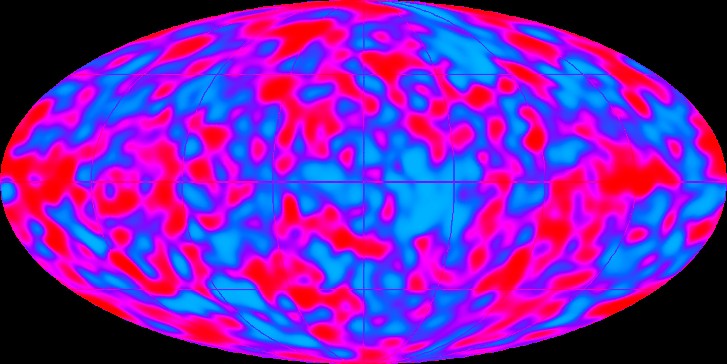
Note: The image above is NASA's all-sky map frm the COBE Explorer.

Friday, July 18, 2008

Philosopher: God is not dead, and physics arguments are one of the reasons

In a ground-breaking article in Christianity Today, philosopher William Lane Craig takes to task the recent spate of shallow village-atheist books because

New Atheism lacks intellectual muscle. It is blissfully ignorant of the revolution that has taken place in Anglo-American philosophy. It reflects the scientism of a bygone generation rather than the contemporary intellectual scene.
Interestingly, arguments from physics play a key role in Craig's view, for example the kalam cosmological argument:

This version of the argument has a rich Islamic heritage. Stuart Hackett, David Oderberg, Mark Nowacki, and I have defended the kalam argument. Its formulation is simple:

1. Everything that begins to exist has a cause.
2. The universe began to exist.
3. Therefore, the universe has a cause.

Premise (1) certainly seems more plausibly true than its denial. The idea that things can pop into being without a cause is worse than magic. Nonetheless, it's remarkable how many nontheists, under the force of the evidence for premise (2), have denied (1) rather than acquiesce in the argument's conclusion.

Atheists have traditionally denied (2) in favor of an eternal universe. But there are good reasons, both philosophical and scientific, to doubt that the universe had no beginning. Philosophically, the idea of an infinite past seems absurd. If the universe never had a beginning, then the number of past events in the history of the universe is infinite. Not only is this a very paradoxical idea, but it also raises the problem: How could the present event ever arrive if an infinite number of prior events had to elapse first?

Moreover, a remarkable series of discoveries in astronomy and astrophysics over the last century has breathed new life into the kalam argument. We now have fairly strong evidence that the universe is not eternal in the past, but had an absolute beginning about 13.7 billion years ago in a cataclysmic event known as the Big Bang.

The Big Bang is so amazing because it represents the origin of the universe from literally nothing. For all matter and energy, even physical space and time themselves, came into being at the Big Bang. While some cosmologists have tried to craft alternative theories aimed at avoiding this absolute beginning, none of these theories have commended themselves to the scientific community.

In fact, in 2003 cosmologists Arvind Borde, Alan Guth, and Alexander Vilenkin were able to prove that any universe that is, on average, in a state of cosmic expansion cannot be eternal in the past but must have had an absolute beginning. According to Vilenkin, "Cosmologists can no longer hide behind the possibility of a past-eternal universe. There is no escape, they have to face the problem of a cosmic beginning." It follows then that there must be a transcendent cause that brought the universe into being, a cause that, as we have seen, is plausibly timeless, spaceless, immaterial, and personal.
Or else ... there are a zillion flopped universes out there, and all your nightmares are alive and are coming to get you ... [!!!]

To protect yourself, immediately invoke O'Leary's Protocol:
1. If it sounds nuts, assume it is.
2. Lay off the beer.
3. Cork the Kickin' Ass hot sauce.
4. When in doubt, doubt.
5. And if it sounds unbelievable, don't believe it.
6. Rinse face. Repeat, as needed, especially 2. and 3. ...
7. Pray. If God is trying to get your attention, don't argue, listen.

Monday, August 4, 2008

What Big Bang theory and Thomas Aquinas's proof of God have in common

Still reading Scott Hahn and Benjamin Wiker's Answering the New Atheism (Emmaus Road, 2008). They note that three of Thomas Aquinas's proofs of God's existence make exactly the same assumption as the 20th century scientists who inferred that if one played the present state of our universe backward, one would come to a point outside of space or time or the laws of nature - a singularity - and that this point must either be a cause or else have a cause because the universe cannot come from nothing:
"Since we see that everything in nature is contingent (St. Thomas's third proof), then something non-contingent will ultimately have to ground the contingent," is the same kind of reasoning as "Since the universe is expanding, then it must have arisen from an infinitely dense 'point'" (p. 69)
Richard Dawkins attacks Thomas's proofs of God, they say, without seeming to understand the underlying point, that nature must have a cause that lies outside it. They conclude,
If St. Thomas is wrong in using this kind of proof, then Dawkins must likewise reject the kind of reasoning that led to the revelation of the Big Bang. In each case, because of the way nature is, we find that we must have a "terminator" (to use Dawkins' inapt word), something that is other than nature as we know it, and that exists as a cause of nature as we know it. Furthermore, St. Thomas adds, in each of the proofs, something like, "This all men speak of as God," and not "This is God." The reason for this is important: there is asignificant difference between knowing that there must be such a cause, and identifying who or what the cause is. (p. 69)
But let's keep in mind here that the Big Bang was a very unpopular theory with atheists and was accepted only under duress ...

See also: Chance - you mean, it isn't really a "thing"?

(Note: The image of the opening of Aquinas's great work, Summa Theologiae, is from Wikimedia Commons.)

Sunday, June 8, 2008

Hints of a time before the big bang? Or of reaching for a story?

Does our universe contain hints of a time before the Big Bang?, based on the cosmic microwave background?:
Although this microwave background is mostly smooth, the Cobe satellite in 1992 discovered small fluctuations that were believed to be the seeds from which the galaxy clusters we see in today's Universe grew.

Dr Adrienne Erickcek, and colleagues from the California Institute for Technology (Caltech), now believes these fluctuations contain hints that our Universe "bubbled off" from a previous one.

Their data comes from Nasa's Wilkinson Microwave Anisotropy Probe (WMAP), which has been studying the CMB since its launch in 2001.
Apparently, on one side of the sky, the cosmic microwave background fluctuations are 10% stronger than on the other.
Sean Carroll conceded that this might just be a coincidence, but pointed out that a natural explanation for this discrepancy would be if it represented a structure inherited from our universe's parent.
The problem to solve, according to the BBC News article, "Hints of 'time before Big Bang" by Chris Lintott (Co-presenter, BBC Sky At Night, St Louis, US) is the fact that time runs in only one direction - forward - but other forces in nature can be reversed. Conventionally, the second law of thermodynamics is held responsible. But, says Prof. Sean Carroll (California Institute of Technology), cosmologists should broaden their horizons.

An American physicist friend insists that this is all "horse puckey", and I suspect he is right. Any time something can be reasonably explained as just "a coincidence", one might perhaps best explain it that way.

Thursday, January 6, 2011

Are you sitting down?: The Pope thinks God is behind the universe

The Pope has gone on record as saying “God was behind Big Bang, universe no accident” (Philip Pullella, 2011 01 06):
God's mind was behind complex scientific theories such as the Big Bang, and Christians should reject the idea that the universe came into being by accident, Pope Benedict said on Thursday.
Most of the Yahoo article is the usual pop media sludge (= Pope grudgingly accepts reality while retaining a tiny corner for dumb people to pray in).

However, to their credit, the Yahooligans couldn’t quite bring themselves to say “the Pope supports evolution”. Instead:
While the pope has spoken before about evolution, he has rarely delved back in time to discuss specific concepts such as the Big Bang, which scientists believe led to the formation of the universe some 13.7 billion years ago.
Yes, and the Pope has made quite clear where he stands on the only theory of evolution currently on offer, in the public media, Darwinism: He had prayer cards put out in many languages all over Rome a few years ago, saying “We are not some casual and meaningless product of evolution.” Some people have a really hard time accepting the significance of that.

Benedict XVI is not heedless of the politically motivated falsehoods circulated about Catholic teachings, always with the intention of confusing Christians who are trying to be faithful. Recently, some American Catholic-label politicians who tried to claim that the Catholic Church has never been certain in its stand against abortion were rebuked by the Vatican.

In fact, most popular culture isn’t sure whether to acknowledge God or the multiverse, and is simply waiting to see who wins the public relations war: Him or Them.

Friday, July 4, 2008

Why is the cosmological argument for the existence of God important?

I've been rereading David Berlinski's The Devil’s Delusion: Atheism and Its Scientific Pretensions (for a review I am writing), and happened on this:
It is one thing to deny that there is a God; it is quite another to deny that the universe has a cause. What remains, if the universe does have a cause, is the gap between what brought the universe into existence and traditional conceptions of the deity. This is no trivial matter. Nonetheless, the cosmological argument succeeds in displacing the burden of proof from its starting point (Is there a God?) to a place much later in the argument (Is it right and proper to think that the cause of the universe is God? ) (p. 64)

Also, on physicists' response to the Big Bang: After Penzias's famous comments,

Physicists quickly came to their senses, They discovered elaborate reasons to avoid the obvious, not least of which, the fact that the obvious was obvious. For more than a century, physicists had taken a manful pride i the fact that theirs was a discipline that celebrated the weird, the bizarre, the unexpected, the mind-bending, and the recondite. Here was a connection that any intellectual primitive could at once grasp: The universe had a beginning, thus something must have caused it to begin. Where would physics be, physicists asked themselves, if we had paid the slightest attention to the obvious." Philosophers helped by asserting that a beginning wasn't really a "beginning" But observation and theory met in the Big Bang and would not go away.

And
"Perhaps the best argument in favor of the thesis that the Big Bang supports theism," the astrophysicist Christopher Isham has observed, "is the obvious unease with which it is greeted by some atheist physicists. At times this has led to scientific ideas, such as continuous creation or an oscillating universe, being advanced with a tenacity which so exceeds their intrinsic worth that one can only suspect the operation of psychological forces lying very much deeper than the usual academic desire of a theorist to support his or her theory." (P. 81)
And more. But now get your own copy. I am not spending the rest of the summer typing!

Here's the review:

Introduction:Berlinski, the devil, and the long spoon
Part One: Taking the measure of the new religion of science
Part Two: Materialism conflicts with evidence more than theism does
Part Three: Evolutionary psychology - the saints' legends of scientism
Part Four: The duty Berlinski never accepted

Friday, October 17, 2008

More fine tuning stories here

New podcasts on fine tuning of the universe

Also: Gravity doesn't make sense? Hold on to that thought!

Multiverse: Getting comfortable with a zillion of everything that is unique?

Can the laws of physics evolve?

Like clouds in our coffee, all these other universes

Major media, imagining themselves sober, think there are many universes, not just double vision

The Big Bang exploded; seriously, is there room for reasonable skepticism about the Big Bang?

Could God live in an infinite sea of universes? It depends.

Will the cosmic multiverse landscape ensure the triumph of intelligent design?

Now, remind me again why we need multiverse theory in the first place?

Multiverse theory: Replacing the big fix with the sure thing?