Showing posts with label science teaching. Show all posts

Monday, June 23, 2008

Teacher: Big ideas without science methods are blank cheque

Recently, I responded to Brian Greene's suggestion that science teachers should teach the big ideas in science, to get students interested. My point was that without a grasp of the underlying principles and fact base, the big ideas in science will not be distinguishable from big ideas in science fiction. A physics teacher kindly writes to comment:

A few thoughts here:

1. The small details in Science are what actually makes up the big picture. Scientific knowledge is like a jigsaw puzzle made up of many small interlocking pieces. One cannot intelligently embrace a large idea, e.g., the Big Bang, without first comprehending the many little ideas that built up to it. Otherwise one is signing a blank cheque.

2. Science is much more an epistemology than a body of knowledge. The goal of science teaching is to get students to think this way: recognise a problem, formulate hypotheses which can be tested experimentally, design and carry out experiments which test one variable at a time, repeat experiments for clarity of results, and draw conclusions from those results to modify or validate the hypotheses. That's the scientific method, limited in scope but powerful in application.

3. Unless one has undergone the discipline of thinking through the steps of the method, one has no idea how much certainty one can place in the various pieces of the puzzle. I have a great deal of confidence in some aspects of modern cosmology because I know the experimental basis for them; an example of this would be the tri-hydrogen reaction. On the other hand, some aspects are almost pure speculation (gravitons, for example) and I can hold onto them very lightly. The speculation is necessary, not only because the human mind wants to see the whole picture even when a puzzle piece is missing, but also because the missing pieces provide a locus for new experimentation.

Signing a blank cheque? That reminds me of the spectacular claim in the May 2003 SciAm article by Max Tegmark that

Cosmologists infer the presence of Level II parallel universes by scrutinizing the properties of our universe. These properties, including the strength of the forces of nature and the number of observable space and time dimensions, were established by random processes during the birth of our universe. Yet they have exactly the values that sustain life. That suggests the existence of other universes with other values.
Now, talk about a blank cheque! Our universe looks fine-tuned so there must be a zillion flops out there.

Saturday, June 21, 2008

Science teaching: The peril in the big questions


Physicist Brian Greene urges a soldier in Iraq, "Put a little science in your life"in a recent New York Times article (June 1, 2008).

The soldier had written him to say that

in that hostile and lonely environment, a book I’d written had become a kind of lifeline. As the book is about science — one that traces physicists’ search for nature’s deepest laws — the soldier’s letter might strike you as, well, odd.

But it’s not. Rather, it speaks to the powerful role science can play in giving life context and meaning.
Greene feels that the way science is taught today robs it of that context and meaning. Students, he says, are taught the technical details, in the belief that they must master A before moving on to B. But, he believes,

In fact, many students I’ve spoken to have little sense of the big questions those technical details collectively try to answer: Where did the universe come from? How did life originate? How does the brain give rise to consciousness? Like a music curriculum that requires its students to practice scales while rarely if ever inspiring them by playing the great masterpieces, this way of teaching science squanders the chance to make students sit up in their chairs and say, “Wow, that’s science?”
Okay, but here's the problem, Brian: Wow. That's NOT science.

If I understand Big Bang cosmology (the accepted view) correctly, the universe didn't come "from" anywhere. There was no From to come from.

True, many current cosmologists are flirting with time before the Big Bang, but that's for young science geniuses, not for the average student, who - when hearing far-flung theories - won't be able to distinguish science from science fiction. Nor can I, in many cases.

Look, half the time, teachers can't get across basic concepts of gravity, like why objects fall into orbit around the Earth. The reason that speculations about time before the Big Bang would interest students is precisely because they distract from the main classroom business of becoming familiar with non-intuitive information and trying to grasp counterintuitive concepts at a much lower level.

And with respect to the origin of life, not only does no one know how life originated, it may never be possible to find out. The best we can really do is construct a model via intelligent design. Then we can only say, it might have happened this way.

Of course, we could then go on to enforce, as a dogma that it did happen this way and declare the problem solved. Presumably, to judge from his other comments, Dr. Greene would not want that outcome. But I bet many others do, because it enables them to declare a problem that is likely unsolveable solved.

And with respect to - for example - how the brain gives rise to consciousness (a key topic of The Spiritual Brain), current neuroscience is wedded to an unworkable approach as a matter of materialist dogma. Again, one unworkable model may briefly triumph and become a dogma, justifying the forays of its fanatics into the persecution of dissenters.

Hello? Did someone mention Darwinian evolution? No, Greene wisely doesn't. What I thought was him mentioning Darwinian evolution was just another Darwin mob thundering by, trundling an increasingly shabby Icon of the Peacock's Tail.

Essentially, Greene means well but science teachers can only do what he wants by turning science into a sort of religion. The new religion may inspire people, of course, but - especially in science - the devil lurks in the details. In this case, the details that will not be properly learned, which are necessary for proper evaluation of the claims made.
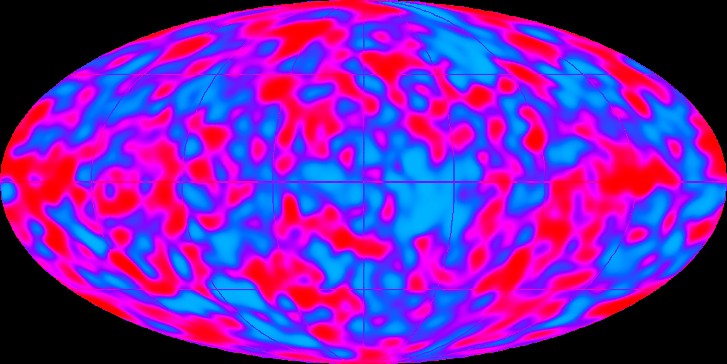
Note: The image above is NASA's all-sky map frm the COBE Explorer.