Showing posts with label Big Bang. Show all posts

Tuesday, January 18, 2011

Word on the street: The clock did SO start at the Big Bang!

Here Edwin Cartlidge reports,
Our view of the early Universe may be full of mysterious circles — and even triangles — but that doesn't mean we're seeing evidence of events that took place before the Big Bang. So says a trio of papers taking aim at a recent claim that concentric rings of uniform temperature within the cosmic microwave background — the radiation left over from the Big Bang — might, in fact, be the signatures of black holes colliding in a previous cosmic 'aeon' that existed before our Universe.

[ ... ]

Penrose, however, thinks that the Universe's great uniformity instead originates from before the Big Bang, from the tail end of a previous aeon that saw the Universe expand to become infinitely large and very smooth. That aeon in turn was born in a Big Bang that emerged from the end of a still earlier aeon, and so on, creating a potentially infinite cycle with no beginning and no end.

Now Gurzadyan and Penrose's idea is being challenged by three independent studies, all posted on the arXiv server within the past few days, by Ingunn Wehus and Hans Kristian Eriksen of the University of Oslo2; Adam Moss, Douglas Scott and James Zibin of the University of British Columbia3 in Vancouver, Canada; and Amir Hajian of the Canadian Institute for Theoretical Astrophysics in Toronto, Ontario4.

- “No evidence of time before Big Bang: Latest research deflates the idea that the Universe cycles for eternity.” Nature News (10 December 2010)
Sounds like bash Roger (“eternally cycling universe”) Penrose”time again (he’s fronting the view they oppose, that things happened before the Big Bang).

Best guess: Penrose gets all the press because the pop sci public needs new universes.

Saturday, October 30, 2010

Vid: The prequel to the Big Bang?

A friend points to a popular overview of current ideas in theoretical physics on pre-Big Bang cosmology, check out "What Happened Before the Big Bang?" a recent episode of the BBC's Horizon series.

It's on YouTube in six parts, featuring Michio Kaku, Neil Turok, Lee Smolin, Andre Linde, Roger Penrose, and Laura Mersini-Hougton


What do you think? Is this science or wishful thinking?

To comment, go here.

See also:

More demolition teams trying to blow up the Big Bang

Big Bang exploded?: Seriously, is there room for reasonable skepticism about the Big Bang?

For Roger Penrose: "When I say it, it's science; when he says it, it'sreligion!

For Lee Smolin: Can the laws of physics evolve?

and

Like clouds in our coffee ... all these other universes

For Neil Turok: So Stephen Hawking is coming to Canada, sort of

Friday, January 23, 2009

Universe: Old-fashioned TV static is signal from deeps of time?

Apparently so.

Here's a cool site from the University of Toronto. It features stuff like:
These days astronomers aren't just picking up signals from a time shortly after the universe began – they're creating maps of those signals to answer some of our deepest questions about the cosmos.

An old-fashioned TV with rabbit ears is designed to pick up very high frequency radio waves. When the TV is tuned to a channel for which there is no nearby broadcaster, the screen shows a lot of static. The static – also known as noise – is caused by random radio waves coming towards the TV from various manmade and natural sources, including deep space.

In the 1960's, Arno Penzias and Robert Wilson, two researchers at Bell Laboratories in New Jersey, began searching for sources of static for the purpose of improving satellite communication. They were searching in the "microwave" part of the radio spectrum, which lies at a somewhat higher frequency than a typical TV receives. What they discovered was that no matter where in the sky they pointed their special antenna it always picked up some microwave noise that could not be accounted for. Astrophysicists eventually realized that this noise was a predicted side effect of the birth of the universe billions of years ago.
Just remember that when deciding how to dispose of Grandpa's old TV in an environmentally friendly manner.

Wednesday, January 21, 2009

Big Bang: God found guilty of existing due to Big Bang evidence?

Frank Turek writes that the Big Bang is evidence for God:

When I debated atheist Christopher Hitchens recently, one of the eight arguments I offered for God’s existence was the creation of this supremely fine-tuned universe out of nothing. I spoke of the five main lines of scientific evidence—denoted by the acronym SURGE—that point to the definite beginning of the space-time continuum. They are: The Second Law of Thermodynamics, the Expanding Universe, the Radiation Afterglow from the Big Bang Explosion, the Great galaxy seeds in the Radiation Afterglow, and Einstein’s Theory of General Relativity.

While I don’t have space to unpack this evidence here (see
I Don’t Have Enough Faith to Be an Atheist), it all points to the fact that the universe began from literally nothing physical or temporal. Once there was no time, no space, and no matter and then it all banged into existence out of nothing with great precision.

The evidence led astronomer Dr. Robert Jastrow—who until his recent death was the director of the Mount Wilson observatory once led by Edwin Hubble—to author a book called God and the Astronomers.

More here.

Hat tip to the Binks at Free Mark Steyn - your one stop shop for intellectual freedom in Canada.

Tuesday, July 8, 2008

Will the rarity of the element lithium endanger the Big Bang theory?

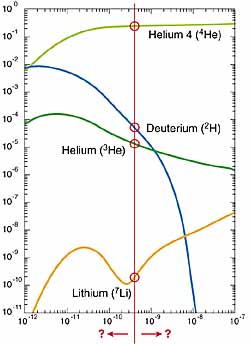
Matthew Chalmers has a story in New Scientist (07 July 2008), "Lithium: The hole in the big bang theory", which addresses the problem the early forged light element lithium may present for the Big Bang theory (paywall). In this 2007 PhysicsWorld article, "Testing the elements of the Big Bang", Kenneth Nollett explains that most of the elements with which we are familiar (oxygen, calcium, carbon) were forged inside stars long after the Big Bang. However,

One big exception is hydrogen: almost all hydrogen nuclei are protons that emerged from the Big Bang almost 14 billion years ago. Another is light nuclei such as deuterium and lithium, which were produced in a process called Big Bang nucleosynthesis that occurred when the universe was only a few minutes old.

The nucleosynthesis, in which the other light elements, including lithium and helium, originated, is thought to have lasted only a few minutes. So why a problem?

Recent measurements of the cosmic background radiation, which reveals the universe as it was when atoms formed about 380,000 years after the Big Bang, and of the large-scale distribution of galaxies have greatly increased the precision of cosmological data. So far it seems that the observed primordial abundances – particularly those of lithium – do not quite tally with BBN theory. The goal now is to bring BBN into line with the new precision of cosmology, and to improve our understanding of the astrophysical environments where the primordial abundances are observed.
Basically,

BBN predicts that there are 4.7 × 10⁻¹⁰ lithium-7 atoms for every hydrogen atom, while the Spite-plateau stars contain only about 1.4 × 10⁻¹⁰. Several explanations for this discrepancy have been proposed, but no-one knows the right answer. Either some important physical process is missing from BBN theory, some astrophysical mechanism destroys large amounts of lithium-7 after BBN, or there is something is wrong with our interpretation of stellar spectra.
Lithium, of course, is much better known to the public than its rarity would suggest because of its fabled role in the treatment of mental illness.

(Note: The chart is from NASA's "Universe 101.")